
Personal narrative by Jason McCarthur
You may wonder why the squid became my emblem - why this particular creature weaves through so much of my work. The answer lies in the salt air of a small town on the Yorke Peninsula, in the glitter of sunlight on Spencer Gulf, and in three weeks each year that shaped how I see.
Edithburgh. Even now the name pulls me back.
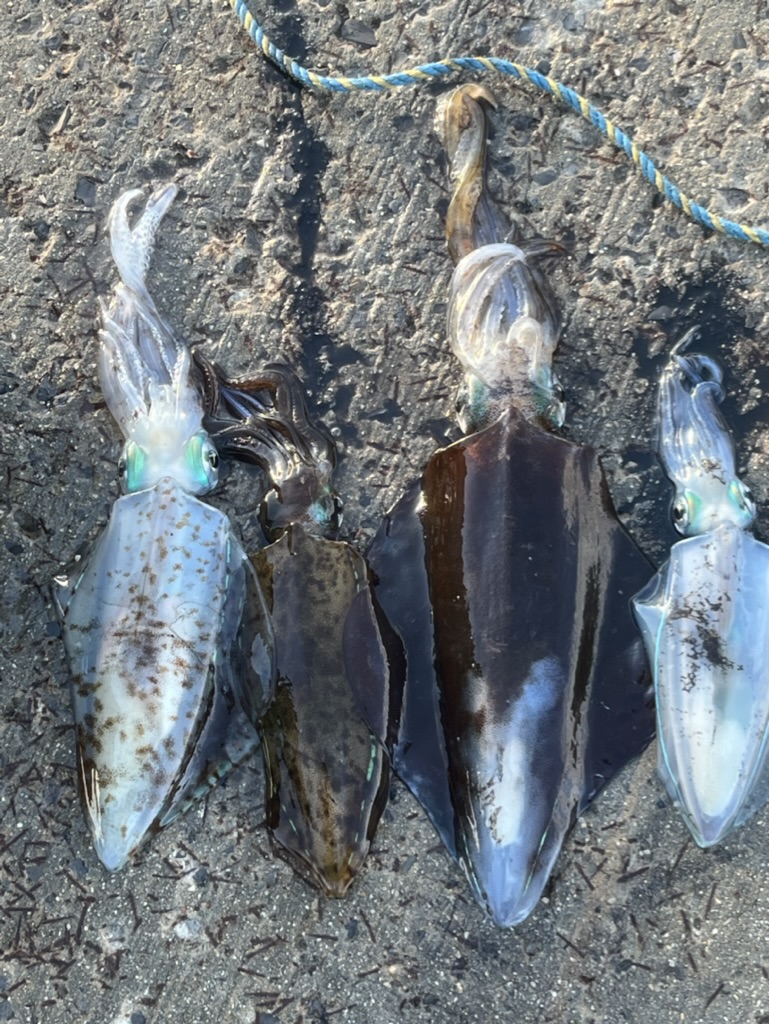
As a teenager, my family would travel there from Adelaide for our annual holiday - a ritual of escape from the dust and heat of the outback into the cool, breathing world of the coast. For the locals and visitors alike, “squidding” was simply part of life. But for me, it became something closer to fascination. I was captivated by everything about them: the way they looked, the way they were caught, the way they tasted.
I learned the craft from watching others on the jetty. You’d use a teaser - a simple Tommy Ruff lure on a line - to draw the squid in close to the pylons or further out into the channel. Once you spotted them, you’d drop another line fitted with a squid jag, then swiftly pull the teaser away. The squid, in their instinctive dart, would strike at the jag. And if fortune held, you’d haul up the makings of a meal that would define the evening: fresh calamari, simply prepared, tasting of the sea and the moment.
But the catching was only ever a prelude to the watching.
Squid are long-bodied molluscs, yet they move through water with a grace that seems to belong to another element entirely. They don’t swim so much as flow - bodies rippling, fins undulating, colour shifting in subtle waves across their skin as they respond to environment or mood. One moment they’re pale as sand, the next dappled with the shadows of the jetty, the next flushed with the urgency of escape or pursuit. They can appear in schools, synchronised and purposeful, or alone, a single hunter drifting through the blue.
To watch a squid move with such power and precision is to recognise that we are not the only creatures on this planet possessed of intelligence. Their large eyes track you with an unnerving awareness. Their eight arms and two longer tentacles are instruments of both delicate touch and fierce capture. And hidden within that soft body is a beak like a bird’s - capable of a bite that commands respect.
Many times at Edithburgh I slipped into the water with mask and snorkel, drifting near the jetty’s shadow. And many times I came face to face with squid - sometimes a school passing in fluid formation, sometimes a solitary individual hanging motionless, watching me as I watched it. Through the glass of my goggles I would lose all sense of time, suspended in the quiet of their world. Their movement is pure gesture, without beginning or end - a kind of living calligraphy.
It is that quality I have spent years trying to capture in paint.
When I paint a squid, I am not simply rendering an animal. I am reaching for those memories - the splash of the jag, the taste of salt on my lips, the weight of a line going taut, the hush of the underwater world. I am reaching for the happiness and peace of mind that those Edithburgh holidays gave me, and that the image of the squid still evokes. Each brushstroke is a kind of return.
Scientifically, of course, squid are cephalopod molluscs - members of the same family as octopus, cuttlefish and nautilus. They are among the ocean’s swiftest and most adaptable creatures, capable of extreme propulsion via jetting, and masters of camouflage that would beggar any human technology. Their eyes are among the largest in the animal kingdom relative to body size, and their nervous systems are complex in ways we are only beginning to understand. They are found in every ocean, in myriad forms, yet the essential architecture remains: the mantle, the fins, the arms, the beak, the ink.
And that ink - it has its own resonance for me. A defence, a distraction, a veil. But also, in my studio, a material. I have used actual squid ink in drawings, watching it bloom across paper like the very creature it came from. There is a rightness in that.
When you eat calamari - properly cooked, so that it yields tenderly to the tooth - you taste the sea at its best. Overcook it, and it becomes tough, unforgiving. It is a lesson in precision. But the squid is so much more than food. It is a reminder that grace and power can coexist, that intelligence need not resemble our own to be real, that beauty can be found in the most unexpected of forms.
I love painting squid because they connect me to all of this: to my younger self standing on a jetty at dawn, to the cool shock of South Australian water, to the patient observation that teaches us to see. They are, truly, one of nature’s gifts.
And so when you see the squid logo on a canvas, a print, or a tote bag, know that it carries more than my name. It carries Edithburgh. It carries the shimmer of a creature changing colour in the shallows. It carries years of looking, and a lifetime of being grateful for what I’ve seen.
- Jason McCarthur, based on his view and knowledge of squid.